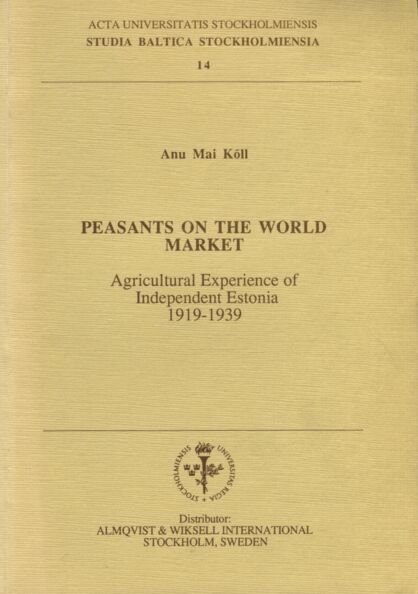
Peasants on the World Market
Centre for Baltic Studies at the University of Stockholm 1994
The aim of the book is to explore a case of peasant-based economic development on an extremely difficult world market. In newly independent Estonia, agriculture became the leading export sector in the turn from a protected Russian market to a relatively open and demanding Western European market.
A thorough land reform and a high degree of cooperative organization made for a solution of the most pressing problems in the countryside, land hunger and lack of capital. However, in the depression of the 1930's these measures were not sufficient. Instead, forceful state involvement and regulation of agricultural markets and organizations followed.
The aim of the book is to explore a case of peasant-based economic development on an extremely difficult world market. In newly independent Estonia, agriculture became the leading export sector in the turn from a protected Russian market to a relatively open and demanding Western European market.
A thorough land reform and a high degree of cooperative organization made for a solution of the most pressing problems in the countryside, land hunger and lack of capital. However, in the depression of the 1930's these measures were not sufficient. Instead, forceful state involvement and regulation of agricultural markets and organizations followed.
| Tootekood | R0174356 |
|---|---|
| Aasta | 1994 |
| Autor | Anu Mai Kõll |
| Sari | Studia Baltica Stockholmiensia |
| Kirjastus | Centre for Baltic Studies at the University of Stockholm |
| Köide | pehme |
| Lehekülgi | 150 |
| Ümbris | ei |
| ISBN | 9122016546 |
| ISSN | 02825066 |
| Keel | inglise |
| Teema | põllumajandus ja maaelu, Eesti ajalugu |
Kas kõik raamatud on kohe saadaval?
Uued raamatud - suur osa on laos olemas (seisukord>uus), aga suur osa on ka tellimisel (seisukord > uus tellimisel). Tellimisel raamatud saabuvad lattu enamasti 1-2-3 päeva jooksul.
Kasutatud raamatud (seisukord > väga hea, hea, rahuldav) on kõik kohe laos või poes olemas.
Mis siis teha, kui minu otsitud raamat on läbi müüdud?
Leia otsitav raamat täppisotsinguga siit.
Saada oma soov info@raamatukoi.ee. Me salvestame selle ja anname teada, kui raamatu
leiame. Vahel leiame kiiresti, vahel kulub aastaid. On raamatuid, mille järjekorras on mitu inimest.
Kuidas raamatud kätte saab?
Saadame raamatuid kõigisse pakikappidesse ja kulleriga otse tellija aadressile. Raamatuile saab ka ise kauplustesse järele tulla: Harju tn 1 Tallinnas või Lossi tn 28 Viljandis. Soome, Lätti ja Leetu saadame raamatuid nii pakikappidesse kui tavapostiga, mujale maailmas samuti tavapostiga. Loe lähemalt siit.
Millises seisukorras on kasutatud raamatud?
Iga kasutatud raamatu eksemplari juures on märgitud seisukord: väga hea, hea, rahuldav, halb ja vajadust mööda ka täpsustus. Loe lähemalt siit.