
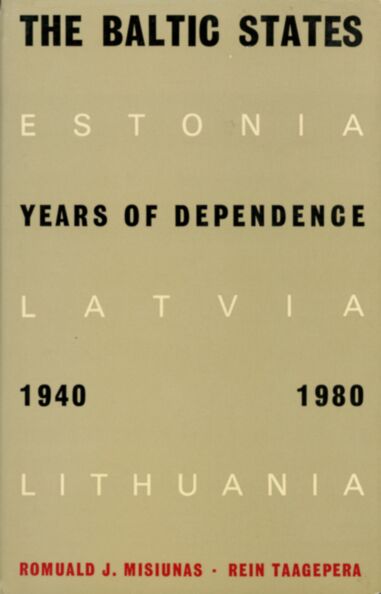
The Baltic States
Hurst & Company 1983
In 1940, as a result of its non-aggression pact with Nazi Germay, the Soviet Union occupied and annexed the three Baltic states: Estonia, Latvia and Lithuania. They had been a part of the Russian Empire since the eighteenth century, achieving political independence in 1918. Come observers thought political annexation in 1940 would result in the eventual assimilation of each state's social and cultural identity. While such predictions are still being voiced in the 1980s, the three national cultures have demonstrated a remarkable resilience in the face of Soviet domination.
This book describes and analyzes the contradiction of political dependence and cultural autonomy in the Baltic nations since their annexation.
Contents:
- Introduction: Historical background The war years: 1940-1945 Postwar Stalinism: 1945-1953 The re-emergence of national cultures: 1954-1968 Centralization and westernization: 1968-1980 The outlook for the 1980s Appendix A. Major Baltic government leaders and administrators, 1938-1980 Appendix B. Tables
In 1940, as a result of its non-aggression pact with Nazi Germay, the Soviet Union occupied and annexed the three Baltic states: Estonia, Latvia and Lithuania. They had been a part of the Russian Empire since the eighteenth century, achieving political independence in 1918. Come observers thought political annexation in 1940 would result in the eventual assimilation of each state's social and cultural identity. While such predictions are still being voiced in the 1980s, the three national cultures have demonstrated a remarkable resilience in the face of Soviet domination.
This book describes and analyzes the contradiction of political dependence and cultural autonomy in the Baltic nations since their annexation.
Contents:
- Introduction: Historical background The war years: 1940-1945 Postwar Stalinism: 1945-1953 The re-emergence of national cultures: 1954-1968 Centralization and westernization: 1968-1980 The outlook for the 1980s Appendix A. Major Baltic government leaders and administrators, 1938-1980 Appendix B. Tables
| Tootekood | R0221988 |
|---|---|
| Aasta | 1983 |
| Autor | Romuald J. Misiunas, Rein Taagepera |
| Kirjastus | Hurst & Company |
| Köide | kõva |
| Lehekülgi | 333 |
| Ümbris | jah |
| Keel | inglise |
| Teema | Eesti ajalugu, maailma ajalugu |
Kas kõik raamatud on kohe saadaval?
Uued raamatud - suur osa on laos olemas (seisukord>uus), aga suur osa on ka tellimisel (seisukord > uus tellimisel). Tellimisel raamatud saabuvad lattu enamasti 1-2-3 päeva jooksul.
Kasutatud raamatud (seisukord > väga hea, hea, rahuldav) on kõik kohe laos või poes olemas.
Mis siis teha, kui minu otsitud raamat on läbi müüdud?
Leia otsitav raamat täppisotsinguga siit.
Saada oma soov info@raamatukoi.ee. Me salvestame selle ja anname teada, kui raamatu
leiame. Vahel leiame kiiresti, vahel kulub aastaid. On raamatuid, mille järjekorras on mitu inimest.
Kuidas raamatud kätte saab?
Saadame raamatuid kõigisse pakikappidesse ja kulleriga otse tellija aadressile. Raamatuile saab ka ise kauplustesse järele tulla: Harju tn 1 Tallinnas või Lossi tn 28 Viljandis. Soome, Lätti ja Leetu saadame raamatuid nii pakikappidesse kui tavapostiga, mujale maailmas samuti tavapostiga. Loe lähemalt siit.
Millises seisukorras on kasutatud raamatud?
Iga kasutatud raamatu eksemplari juures on märgitud seisukord: väga hea, hea, rahuldav, halb ja vajadust mööda ka täpsustus. Loe lähemalt siit.