

A Simple Guide to Retrieval Augmented Generation
Abhinav Kimoth · Manning Publications · 2025
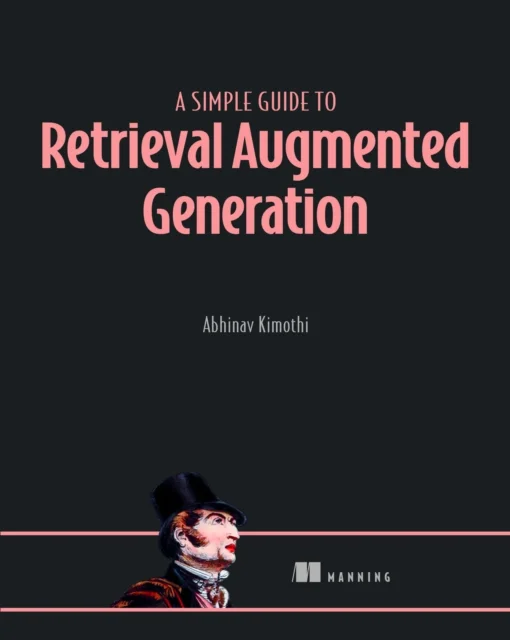
Abhinav Kimoth · Manning Publications · 2025
Everything you need to know about Retrieval Augmented Generation in one human-friendly guide.
Augmented Generation—or RAG—enhances an LLM’s available data by adding context from an external knowledge base, so it can answer accurately about proprietary content, recent information, and even live conversations. RAG is powerful, and with A Simple Guide to Retrieval Augmented Generation, it’s also easy to understand and implement!
In A Simple Guide to Retrieval Augmented Generation you’ll learn:
The components of a RAG system
How to create a RAG knowledge base
The indexing and generation pipeline
Evaluating a RAG system
Advanced RAG strategies
RAG tools, technologies, and frameworks
A Simple Guide to Retrieval Augmented Generation gives an easy, yet comprehensive, introduction to RAG for AI beginners. You’ll go from basic RAG that uses indexing and generation pipelines, to modular RAG and multimodal data from images, spreadsheets, and more.
About the Technology
If you want to use a large language model to answer questions about your specific business, you’re out of luck. The LLM probably knows nothing about it and may even make up a response. Retrieval Augmented Generation is an approach that solves this class of problems. The model first retrieves the most relevant pieces of information from your knowledge stores (search index, vector database, or a set of documents) and then generates its answer using the user’s prompt and the retrieved material as context. This avoids hallucination and lets you decide what it says.
About the Book
A Simple Guide to Retrieval Augmented Generation is a plain-English guide to RAG. The book is easy to follow and packed with realistic Python code examples. It takes you concept-by-concept from your first steps with RAG to advanced approaches, exploring how tools like LangChain and Python libraries make RAG easy. And to make sure you really understand how RAG works, you’ll build a complete system yourself—even if you’re new to AI!
What’s Inside
RAG components and applications
Evaluating RAG systems
Tools and frameworks for implementing RAG
About the Readers
For data scientists, engineers, and technology managers—no prior LLM experience required. Examples use simple, well-annotated Python code.
About the Author
Abhinav Kimothi is a seasoned data and AI professional. He has spent over 15 years in consulting and leadership roles in data science, machine learning and AI, and currently works as a Director of Data Science at Sigmoid.
Table of Contents
Part 1
1 LLMs and the need for RAG
2 RAG systems and their design
Part 2
3 Indexing pipeline: Creating a knowledge base for RAG
4 Generation pipeline: Generating contextual LLM responses
5 RAG evaluation: Accuracy, relevance, and faithfulness
Part 3
6 Progression of RAG systems: Naïve, advanced, and modular RAG
7 Evolving RAGOps stack
Part 4
8 Graph, multimodal, agentic, and other RAG variants
9 RAG development framework and further exploration
Uus kasutamata raamat
Detailid
- Autor
- Abhinav Kimoth
- ISBN
- 9781633435858
- Aasta
- 2025
- Kirjastus
- Manning Publications
- Keel
- inglise
- Köide
- Pehme kaas
- Lehekülgi
- 256
- Teema
- Arvutid ja infotehnoloogia › Programmeerimine ja tarkvaraarendus — Computer programming / software development
- Kaal
- 470 g