

Early History of Magic Cubes (1100–1850)
Jacques Sesiano · Presses Polytechniques et Universitaires Romandes · 2026
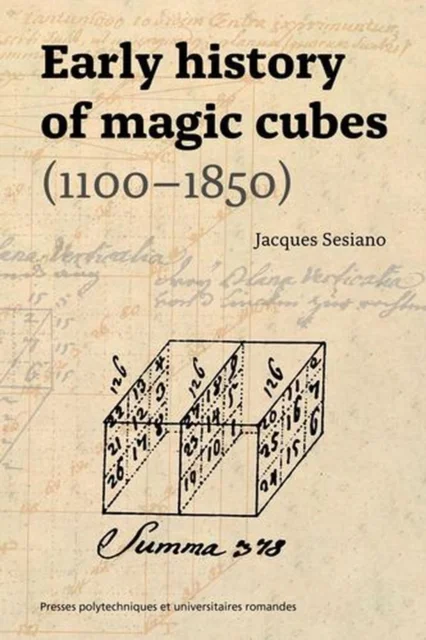
An investigation into the predecessors of the magic cube. Magic cubes are generally considered to have been invented in the second half of the nineteenth century, when the conditions for a cube to be called magic were established: it must display the same sum in each horizontal, vertical, and front-to-back row, as well as in the four internal diagonals of the cube. However, during the preceding seven centuries, constructions of magic cubes had already begun, but obeying other definitions. The first study is found in twelfth-century Persia. Then, Pierre de Fermat (1601-1665) dealt with them in the seventeenth century. Unaware of the existence of predecessors and with a different design, the Frenchman Joseph Sauveur (1653-1716) taught a construction method that was adopted in Gottfried Wilhelm Leibniz’s (1646-1716) circle. This method was expanded in the 1830s but fell into oblivion with the modern definition of the magic cube.
Uus kasutamata raamat
Detailid
- Autor
- Jacques Sesiano
- ISBN
- 9782889156993
- Aasta
- 2026
- Keel
- inglise
- Köide
- Pehme kaas
- Lehekülgi
- 340
- Teema
- Matemaatika ja loodusteadused › Matemaatika — Mathematics
- Kaal
- 616 g