

Japanese Screens
Anne-Marie Christin, Claire-Akiko Brisset, Torahiko Terada · Abbeville Press Inc.,U.S. · 2021
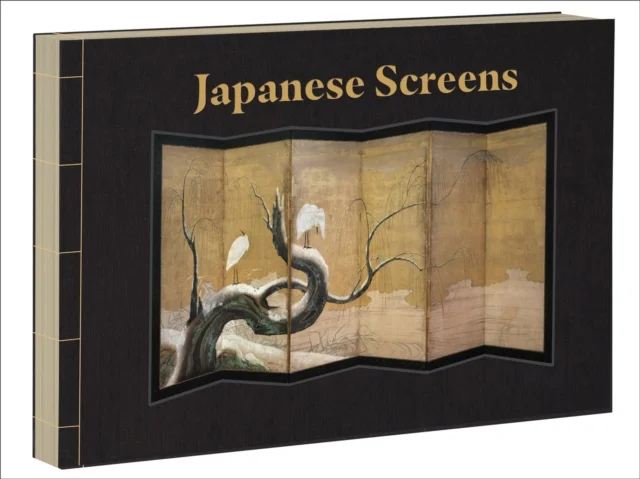
Japanese screens (byobu, meaning “barrier against the wind”) are made of wooden lattices with two to twelve panels, covered with a paper or fabric canvas. They are unique for being beautiful artworks as well as portable furnishings, acting as backdrops for court ceremonies or partitions for intimate tea services. Artists have embraced screens as three-dimensional objects, creating dynamic compositions that guide the viewer’s eye from one panel to the next.
This sumptuous book explores the 1,300-year history of Japanese screens. The authors, leading experts on Japanese art and culture, describe how screens developed from the eighth to the twenty-first century, from their ceremonial use in palaces and temples to their functional and decorative use in ordinary Japanese homes. They examine the stylistic evolution of screens and the wide variety of subjects, such as animals, the seasons, The Tale of Genji, and calligraphic designs.
Bound in the Japanese style and housed in a handsome clamshell box, this volume also comes with a poster-sized reproduction of an exceptional screen, suitable for framing. Japanese Screens will be an essential addition to any art lover’s library.
Uus kasutamata raamat
Detailid
- ISBN
- 9780789214072
- Aasta
- 2021
- Kirjastus
- Abbeville Press Inc.,U.S.
- Keel
- inglise
- Köide
- Kõva kaas
- Lehekülgi
- 280
- Teema
- Kunstid › Kunstiajalugu ja -voolud — History of art / art & design styles
- Kaal
- 3.70 kg