

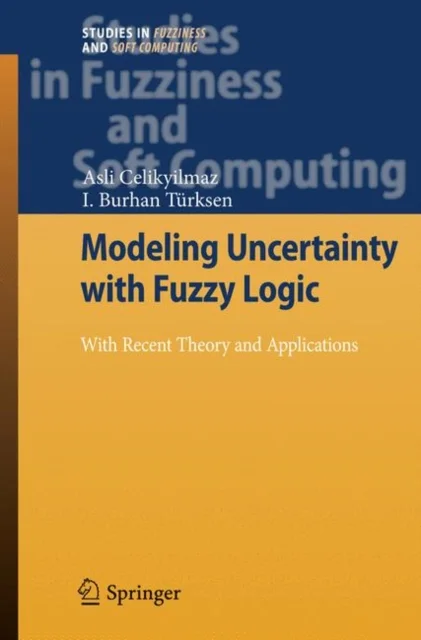
Modeling Uncertainty with Fuzzy Logic
With Recent Theory and Applications
Asli Celikyilmaz, I. Burhan Turksen · Springer-Verlag Berlin and Heidelberg GmbH & Co. KG · 2009
With Recent Theory and Applications
Asli Celikyilmaz, I. Burhan Turksen · Springer-Verlag Berlin and Heidelberg GmbH & Co. KG · 2009
The world we live in is pervaded with uncertainty and imprecision. Is it likely to rain this afternoon? Should I take an umbrella with me? Will I be able to find parking near the campus? Should I go by bus? Such simple questions are a c- mon occurrence in our daily lives. Less simple examples: What is the probability that the price of oil will rise sharply in the near future? Should I buy Chevron stock? What are the chances that a bailout of GM, Ford and Chrysler will not s- ceed? What will be the consequences? Note that the examples in question involve both uncertainty and imprecision. In the real world, this is the norm rather than exception. There is a deep-seated tradition in science of employing probability theory, and only probability theory, to deal with uncertainty and imprecision. The mon- oly of probability theory came to an end when fuzzy logic made its debut. H- ever, this is by no means a widely accepted view. The belief persists, especially within the probability community, that probability theory is all that is needed to deal with uncertainty. To quote a prominent Bayesian, Professor Dennis Lindley, “The only satisfactory description of uncertainty is probability.
Uus kasutamata raamat
Detailid
- Alapealkiri
- With Recent Theory and Applications
- Autorid
- Asli Celikyilmaz, I. Burhan Turksen
- ISBN
- 9783540899235
- Aasta
- 2009
- Keel
- inglise
- Köide
- Kõva kaas
- Lehekülgi
- 400
- Teema
- Tehnika, inseneriteadus, põllumajandus › Tehnika üldiselt — Technology: general issues
- Kaal
- 778 g