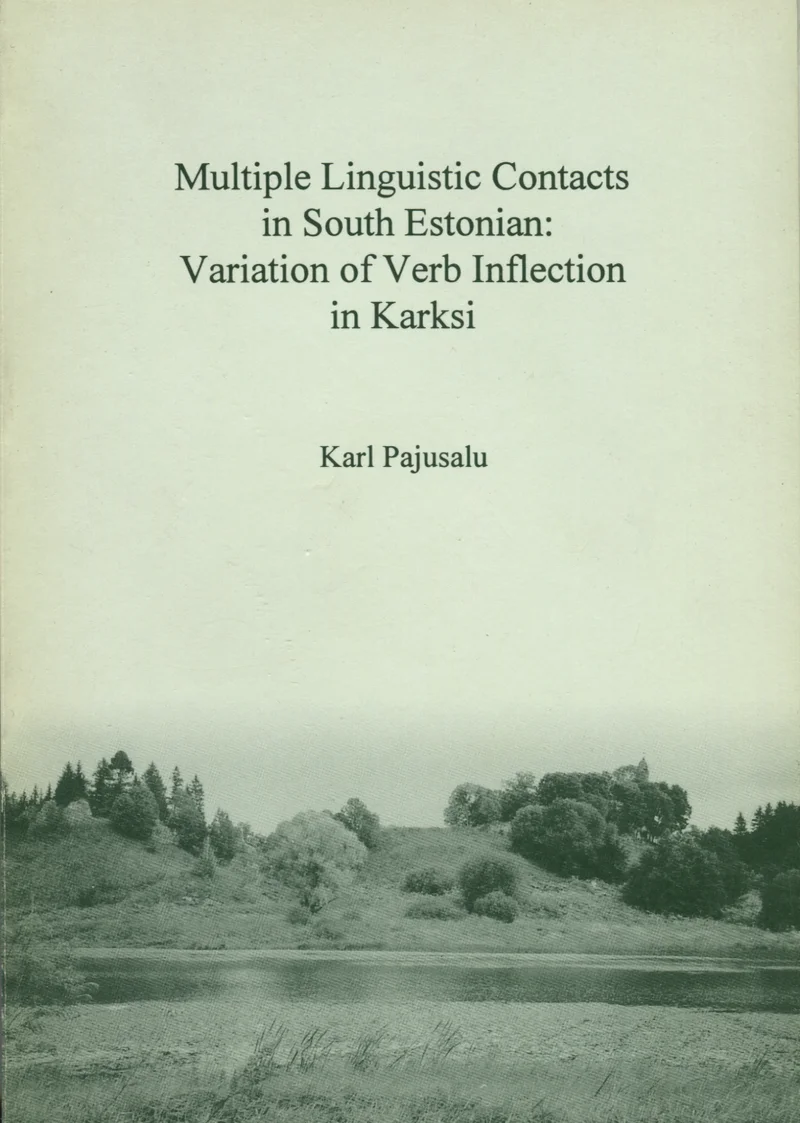
Multiple Linguistic Contacts in South Estonian: Variation of Verb Inflection in Karksi
Karl Pajusalu · Turun Yliopisto · 1996
Karl Pajusalu · Turun Yliopisto · 1996
Autori uurimus karksi murdest on valminud rohkem kui kümneaastase töö jooksul erinevate ülikoolide juures.
The position of South Estonian in the area of Balto-Finnic is unique in several ways. South Estonian has retained some ancient unique features and one can find there such independent innovations that have no equivalents in other Finno-Ugric languages. The differentation between the active and medial conjugations is a well-known example. South Estonian is also an ancient area of language contacts. Of Balto-Finnic languages, Livonian serves as its neighbor; historical contacts with the eastern cognate languages are evident as well. For several millennia, South Estonian has had contacts with a number of Indo-European languages. Relations with the Baltic languages have been strongest because of their proximity, but one has to take into account also Germanic and Slavonic influences.
All this has left a trace in the South Estonian verb inflection.
Contents:
The position of South Estonian in the area of Balto-Finnic is unique in several ways. South Estonian has retained some ancient unique features and one can find there such independent innovations that have no equivalents in other Finno-Ugric languages. The differentation between the active and medial conjugations is a well-known example. South Estonian is also an ancient area of language contacts. Of Balto-Finnic languages, Livonian serves as its neighbor; historical contacts with the eastern cognate languages are evident as well. For several millennia, South Estonian has had contacts with a number of Indo-European languages. Relations with the Baltic languages have been strongest because of their proximity, but one has to take into account also Germanic and Slavonic influences.
All this has left a trace in the South Estonian verb inflection.
Contents:
- Introduction
- On the making and dialect features of Karksi and Mulgi
- Verb inflection in Karksi
- Final e in verb forms of Karksi
- Conclusions
- Appendix
Pakiautomaati 1–2 p Tule ise järele*Hinnad kehtivad veebipoest ostmisel; kauplustes võivad hinnad erineda
Läbi müüdud — jäta soov ja anname teada, kui raamat on jälle saadaval. Tarne ja kättesaamine
Detailid
- Autor
- Karl Pajusalu
- ISBN
- 9512908549
- ISSN
- 03568490
- Aasta
- 1996
- Kirjastus
- Turun Yliopisto
- Keel
- inglise
- Köide
- Pehme kaas
- Lehekülgi
- 388
- Kaanekujundaja
- Hannele Pajula
- Mõõdud
- 210 × 148 mm
- Kaal
- 590 g
- Artikkel
- R0169181
- Märksõnad
- karksi murre, keeleteadus, lõuna-eesti murded, mulgi murre, murdekeel